NASA's most advanced mobile robotic laboratory, the Mars Science Laboratory carrying the Curiosity rover, is set to launch atop an Atlas V rocket on tomorrow Nov. 26 on a mission to examine Gale Crater on Mars that shows geologic evidence of minerals that formed in flowing liquid water.
Apophis is a name later given to an asteriod provisionally named 2004 MN4. It was renamed in 2005 taking the Greek name of the Egyptian god Apep- The Uncreator. Now, why scare people by giving that name? Why not name it like other asteriods ( Polly, Barney)?
Well, turns out there was a reason to scare. Upon its discovery in 2004, it was briefly estimated to have a 2.7% chance of impacting the Earth in 2029. Later calculations showed that that there are no impact risks and instead it will pass Earth below the orbits of our communication satellites on April 13, 2029, However it will return for another close Earth approach in April 13, 2036. During which it will have a small risk of hitting our planet.
To date, scientists are still trying to get better data to predict the precise orbit after 2029. Russian and American astronomers already had and still have disagreements on whether it will hit Earth in 2036 or not. But whichever it is, the danger that asteroids like Apophis hitting our planet very is real (real than those other doomsday scares like the Mayan calendar and 2012). And until we get better data later this year, next year or on 2029, to project impact or not, we will have to prepare for the bad case scenario.
Can we stop it?
The good news is we definitely have better chances than the poor dinosaurs had. We have enough knowledge and technology today to give us a fighting chance to stop an asteroid collision.
The 1998 film Armageddon always comes first to my mind. - Using a nuclear weapon to alter it's course. Although lots of scienctists today would agree it is not really a viable solution. The problem of one body hitting Earth might only be multiplied if the body breaks up into many objects aiming for the planet.
Another popular thought is to use gravity. The theory is that if we are able to place a craft at a certain distance from an asteroid, and use the craft’s thrusters to "tug" the asteroid, it would alter the course enough to steer the body away from earth.
Another of the more popular theories is using the Yarkovsky Effect. An accelerated beam of solar energy would heat the asteriod enough that when it cools off, it would alter the course.
There are lots of other thoughts on how prevent asteroid hitting earth some are not in the mainstream but thanks to scientists(and other geeks and geniuses) who comes up with the ideas.
Its hard to imagine the how far and how large objects are in the solar system if we look at pictures in books (or like the wallpaper i use above).
That picture above is actually scaled to size but it is impossible to scale the distance in a single image. One way to picture the size of the solar system is to reduce all the sizes to something we can easily imagine. Below is a scale I made if we are going to reduce the Sun to the size of a basketball.
I know, we are trying to avoid numbers, so here we go.
Look at the picture below and imagine for a moment that the sun is the size of a regular basketball and the earth is the size of peppercorn or like the yellow round pellet below.
Zoom...
Take the yellow pellet and put it 25.6 meters away from the basketball. Roughly that's end to end of a basketball court(which is regularly 28 meters in length). This is the distance between Sun and Earth. Remember that you live in this tiny yellow pellet. Can you imagine how microscopic you are at this scale. Close your eyes and visualize that for a moment. Then imagine Mars the size half of that pellet and put it 39 meters from the ball. Jupiter, at 133 meter away and so on as the list above goes on
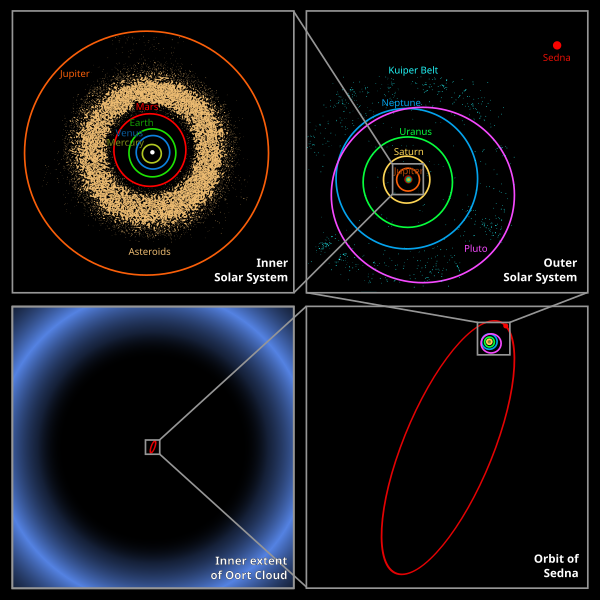
To put Pluto in our picture (about grain of sand in size at this scale), you have to travel 1 kilometer and form our basketball. And this is not the edge - there is still the Kuiper Belt and Oort Cloud.
Kuiper belt
The Kuiper belt is a region of the Solar System beyond the planets extending from the orbit of Neptune (at 30 AU) to approximately 50 AU from the Sun (Earth is 1 AU from the Sun to give you an idea of the distances being considered). Like the asteroid belt, it consists mainly of small bodies, or remnants from the Solar System's formation. While the asteroid belt is composed primarily of rock, ices, and metal, the Kuiper objects are composed largely of frozen volatiles (termed "ices"), such as methane, ammonia and water.
Pluto is the largest known member of the Kuiper belt, if the scattered disc is excluded. Originally considered a planet, Pluto's position as part of the Kuiper belt has caused it to be reclassified as a "dwarf planet"(please read from my other post here). It is compositionally similar to many other objects of the Kuiper belt, and its orbital period is identical to that of the KBOs known as "plutinos". In Pluto's honour, the four currently accepted dwarf planets beyond Neptune's orbit are called "plutoids".
The Kuiper belt should not be confused with the hypothesized Oort cloud, which is a thousand times more distant. The objects within the Kuiper belt, together with the members of the scattered disc and any potential Hills cloud or Oort cloud objects, are collectively referred to as trans-Neptunian objects (TNOs).
The Oort cloud
The Oort cloud is thought to occupy a vast space from somewhere between 2,000 and 5,000 AU to as far as 50,000 AU (7.48E+011 km) from the Sun. In our scale, if you put our basketball in Rizal's Monument in Luneta, you need to travel cross the South China Sea pass Hong Kong to Guangzhou China to get to the estimated outer regions of the Oort cloud. Can you still imagine that you are in that now microscopic yellow pellet?
The Oort cloud is thought to comprise two separate regions: a spherical outer Oort cloud and a disc-shaped inner Oort cloud, or Hills cloud. Objects in the Oort cloud are largely composed of ices, such as water, ammonia, and methane. Astronomers believe that the matter composing the Oort cloud formed closer to the Sun and was scattered far out into space by the gravitational effects of the giant planets early in the Solar System's evolution. Some scientists estimates place the outer edge at between 100,000 and 200,000 AU.
So how far the can Solar System go?
The definition of size of the solar system is an ongoing debate among scientist today. There are mutliple theories and here are two most leading.
1. The solar system extends to the reach of the heliosphere, the region where the solar wind interacts with the interstellar medium and it stops the solar wind from our Sun and the solar winds of other stars holds sway.
2. Another widely held theory is that the Solar System exists to the edge of the Sun’s gravitational influence. That is believed to be about 125,000AU or two light years. Beyond that all objects are more strongly influenced by other stars. The problems with this theory is that science is unable to detect objects at that distance and can not determine beyond a reasonable doubt how they are influenced or by what.
As humans who are used to these measurements from day to day experience, it is normal not being able to put our heads around the sizes, distances, and vastness of the solar system. (let alone the the Milky Way or the visible universe). In it's most literal sense they are truly astronomical.




 Posts
Posts


